PropAMMs: The Future Of Market Microstructure
When we look back on the history of trading in 10 years, it will be clear there were 3 distinct phases:
- Pre-electronic CLOBs
- Electronic CLOBs
- PropAMMs
PropAMMs—proprietary, on-chain automated market making algos running directly on Solana mainnet—are one of the most significant evolutions in market microstructure.
The Traditional CEX Market-Making Model: High-Frequency Ping-Pong
To appreciate the leap, start with how market makers (MMs) operate on today’s dominant centralized exchanges (CEXs)—NYSE, NASDAQ, and CME, as well as Binance, Coinbase, Bybit, etc.
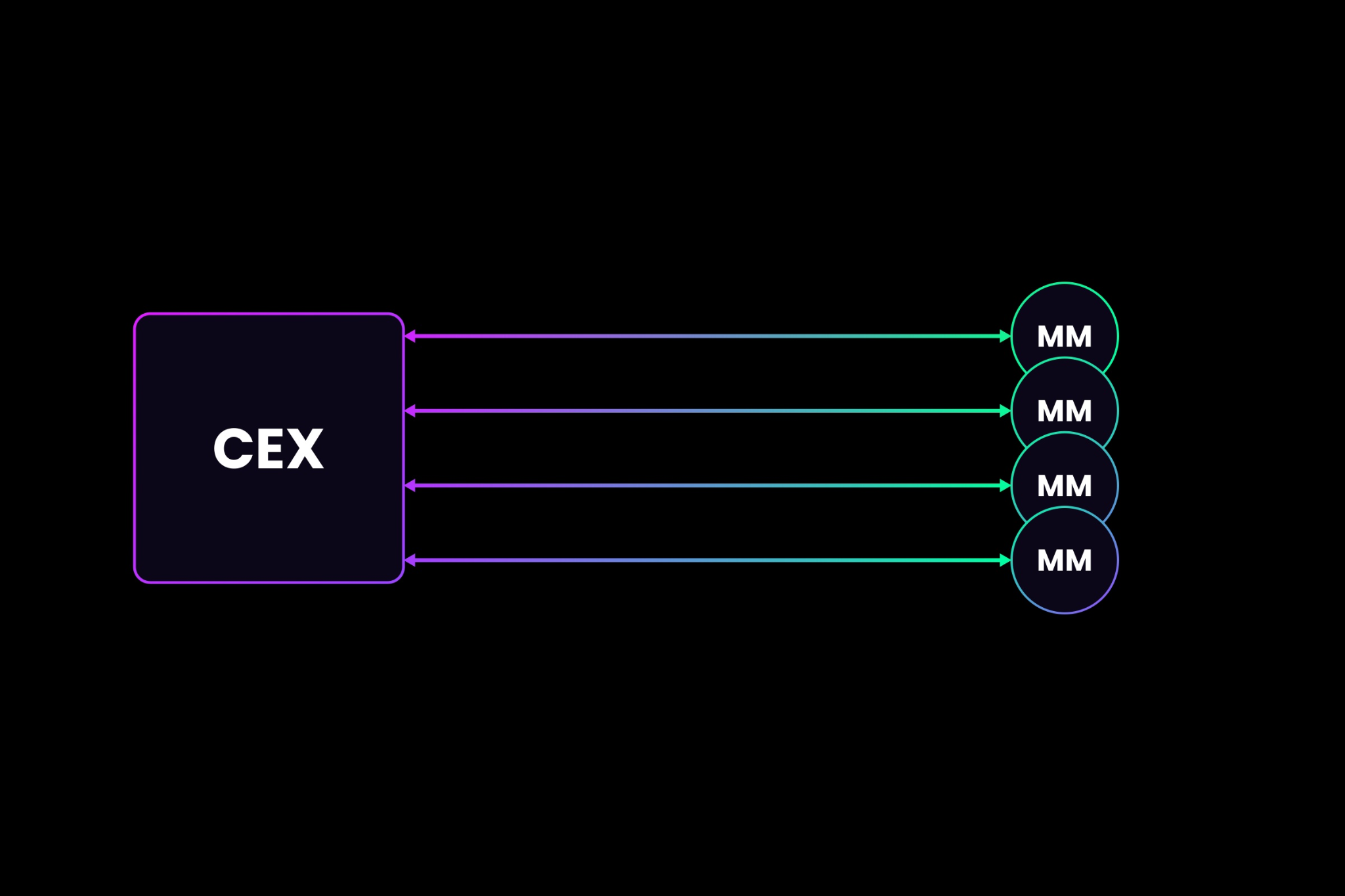
Every MM is physically co-located with the exchange’s matching engine. Picture dozens of high-frequency trading firms each running their proprietary pricing algorithms on dedicated servers in the same data center. These servers are connected to the server that is hosting the matching engine via uniform-length cables (often ~50 meters). Traffic flow looks something like this:
- A retail taker submits a market order.
- The CEX processes it and immediately broadcasts the fill, new top-of-book, and updated state to every MM.
- Each MM’s algorithm reacts—repricing, canceling, or inserting new limits—then fires updated orders back at the CEX.
- The CEX processes all of those changes, and broadcasts again.
- Repeat infinitely.
The messaging volume is enormous. Every single update must traverse the network, be processed by the matching engine, and be disseminated to all participants. This entire process is inefficient because each MM is constantly reacting to information changes from the other MMs every few microseconds.
PropAMMs on Solana: The Exchange Hosts The MMs’ Algos
Now contrast this with PropAMMs on Solana mainnet.
The breakthrough is simple but profound: the market maker’s pricing algorithm is hosted directly by the exchange itself. In practice, the exchange is Solana mainnet. Both the matching engine and the MM algos live on a single piece of silicon.
This means: no more fixed-length cables connecting servers in a room somewhere, and dramatically reduced (~90-99%) aggregate message load; and the ability to respond to price changes atomically.
Let’s consider the same example from earlier. When a retail taker order arrives:
- It lands in the same virtual machine that is running the PropAMM’s pricing logic.
- The MMs’ algos can instantly read the on-chain state (last fill, current inventory, oracle feeds, etc.) and update their quotes without ever leaving the chip.
- No external packets. No inter-server handshakes. No broadcast storm.
- The taker immediately gets the best fill from the best available in realtime. DFlow recently introduced JIT routing.
The electrons only have to move inside a single piece of silicon.
Lowering latency for MMs to quote produces tighter spreads. This isn’t theoretical. PropAMMs are already the dominant quoting mechanism for spot SOL-USDC on Solana, consistently delivering tighter spreads than every major CEX with billions of dollars of daily volume. This has recently become true for ETH as well.
And this is before any of the major upgrades coming to Solana mainnet this year (Alpenglow, Constellation).
The rise of PropAMMs gave me the conviction to predict that Solana mainnet will rival all CEXs for spot and perps by EOY 2026.
Global Latency and Consensus
Critics point out that Solana’s slot time (currently ~400 ms, soon to be 100–150 ms with Alpenglow in ~August) is orders of magnitude slower than TradFi co-lo microseconds. This misses the point entirely.
The relevant latency for market making is not “how fast can the entire global network produce a new block and come to consensus?” It is “how fast can an MM algo reprice after receiving new information?” In the PropAMM model, trading information is made available to all MM algos immediately; no network chatter required.
Yes, PropAMMs in practice depend on oracle updates for each block, but that doesn’t change anything about the preceding paragraph. The system clock is shared; the information propagation delay inside the critical path is effectively zero.
The Primary Remaining Challenge: Guaranteed Best Execution
PropAMMs are not a mature technology; they are about one year old.
They face one meaningful shortcoming: takers currently lack a deterministic “best execution” guarantee across multiple PropAMMs. Each PropAMM’s algorithm is private (as it should be; MMs do not publish their algos), and routing logic across competing PropAMMs is inherently non-deterministic.
This problem is tractable. Aggregators like Jupiter and DFlow (for spot) and emerging perps routers already route intelligently. I expect them to require formal best-execution primitives—price-priority routing, simulated fills, or even on-chain commitments—in 2026. The propAMMs depend on the routers for orderflow, and so the routers can dictate product requirements.
PropAMMs are young, so this hasn’t happened yet, but it will soon.
Solana’s 2026 Roadmap Will Supercharge PropAMMs
PropAMMs are still early and heavily constrained by today’s runtime limits. Solana’s upcoming upgrades will relax many of these constraints, allowing propAMMs to further their lead relative to traditional CLOBs. This year we can expect:
- Higher compute unit (CU) limits per transaction and per block, and larger transaction sizes → more sophisticated pricing models.
- Alpenglow → slot times drop to 100–150 ms.
- DoubleZero → global latency reduction.
- Application-controlled execution → MMs can define custom ordering rules for their algos, including guarantees for maker cancels and taker speedbumps.
- Multiple concurrent leaders → guarantee transaction inclusion at all times.
PropAMMs already beat CEX spreads today. By the end of this year, the evidence will be overwhelming. PropAMMs are the future of market microstructure.