Don't Short Intelligence
The most important chart in technology right now is AI agents that are performing increasingly long-running tasks. This is trending towards infinity.
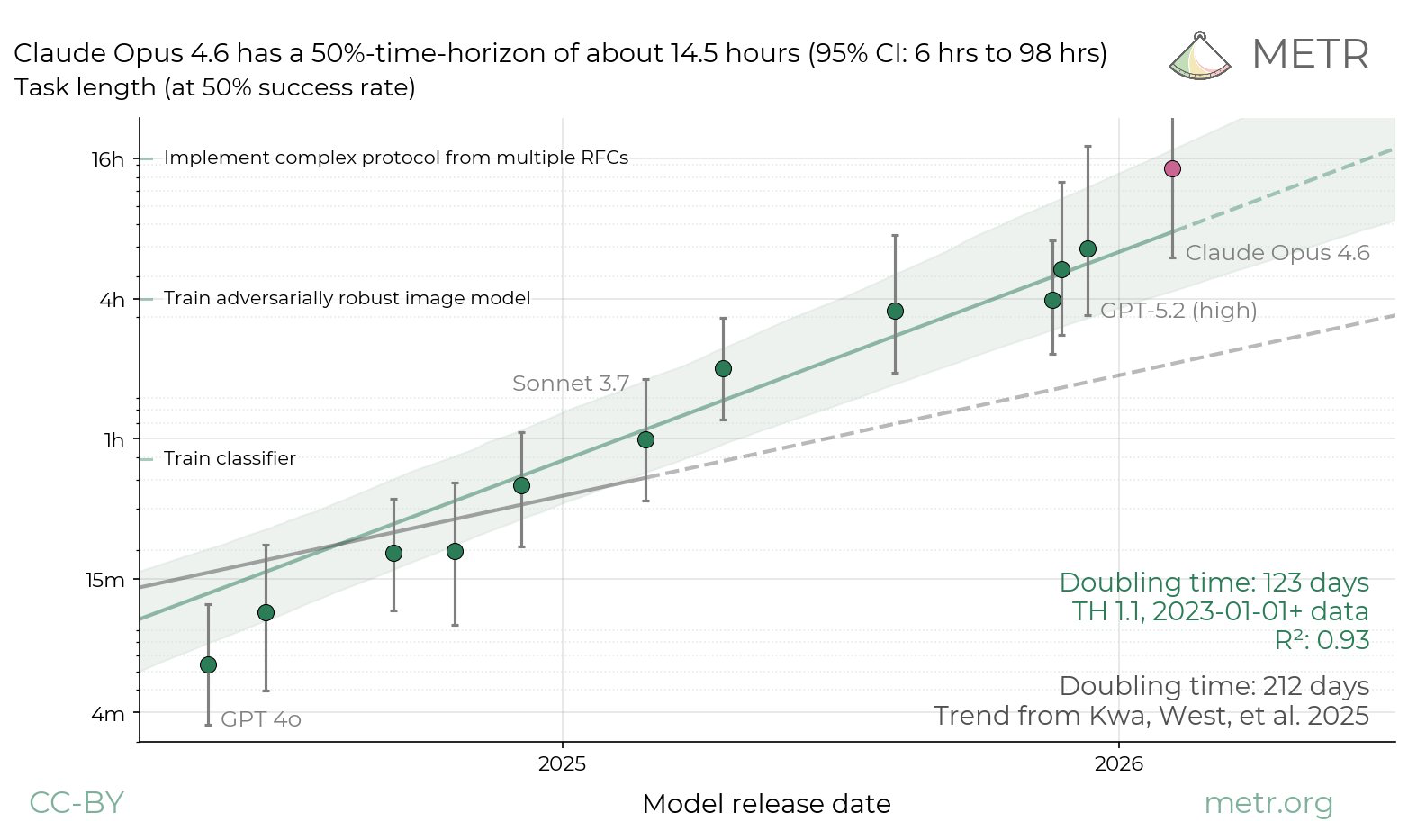
We are moving from chatbots to agents that can iterate over complex tasks for hours or days without human intervention.
The common refrain in SaaS is that ‘systems of record’ like Workday or Salesforce are irreplaceable because of their deep integration into business processes. I am skeptical of this claim on a five-year horizon. In five years, why can’t you ask Claude Code to ‘build me a system of record that replicates every function of my current Salesforce instance, including every custom plugin and workflow’?
Yes, Salesforce is still relevant today as a common standard and schema that agents plug into. But in 5 years, there is a material probability that won’t be true.
There is a real fundamental question about long term durability of any company whose only product output is purely software. It’s not a guarantee these businesses disappear, but there is a substantial non-0 probability they go to 0, and a higher probability that they become structurally impaired.
Addressing The Lump of Labor Fallacy
What about the millenia of evidence that the lump of labor fallacy is wrong?
The lump of labor fallacy does not even attempt to acknowledge what is happening from first principles. AI is not just a new technology that increases economic productivity. It changes the nature of work entirely.
All work - both blue collar and white collar - has two steps:
- Figure out what to do
- Do it
This is true from Sundar Pichai - who guides capital allocation and strategic direction for multi trillion dollar Alphabet - to the janitor, who has to decide whether to go left or right around the desk in the middle of the room first.
Up until the invention of software, substantially all technological innovation improved efficiency of doing the actual work - the wheel, cotton gin, steam engine, car, printing press, etc. Software was a fundamentally new kind of technology, because it allowed humans to program if-then logic to codify human decision making. For the first time ever, software began encroaching on step 1 of work, whereas all prior technology was in the realm of step 2.
It is clear now that transformer based AI systems are the full generalization of step 1. With increasing intelligence and context windows, AI systems will be able to to make decisions that Pichai makes, and that the robotic janitor and taxi driver (Tesla/Waymo FSD) makes.
As you automate an increasing amount of complex decision making itself, there isn’t a higher level of decision making that is unlocked.
At least for the foreseeable future, there is tremendous value in knowing what are the right questions to ask, and how to utilize these systems to their full potential. The system that replaces Salesforce as a system of record is less likely to be someone who works at a company than a net new startup that only ever has a handful of employees who can maximally use these tools to automate decision making at scale and offers a Salesforce quality product with 1/100,000th the cost structure.
Software doesn’t sell itself, but when you can cut the cost of software by 100x or more and automate deployment using AI tools, software almost sells itself.
Longs
If we assume the marginal cost of software production is trending toward zero, what businesses are durable? Here are some areas that are less likely to be disrupted by a rapid growth in intelligence. This list is by no means exhaustive.
Brand and SEO (The Information Aggregators): Products where the moat is the human habit and the external link graph. Yahoo Finance and CoinGecko are great examples. There are millions of human-generated links and citations, and tons of UGC (especially YouTube and TikTok videos) that feature these brands and products that intelligence does not displace.
Entertainment: YouTube, Instagram, TikTok, Reddit, and X will continue to entertain the world, no matter how much intelligence there is. If anything, an abundance of intelligence reinforces the moats of these businesses by making content more tailored, and therefore capturing user attention.
Financial Services: The moat is brand and user trust, not compliance (this can be automated with intelligence!). There isn’t a way to be ‘10x better’ at making ledger entries. The obvious examples here are Robinhood, Revolut, SoFi, and Nubank, in addition to legacy institutions like NYSE and JPM.
Crypto: So long as asset prices are volatile, then crypto rails serve a purpose and can produce profits on near-0 cost. Perhaps when we get to Worldcoin UBI and all commodities have fallen to $0 there will no longer be asset price volatility, but even I’m not projecting that outcome.
Market Makers: So long as asset prices are volatile, market makers will have a market. This includes both traditional market makers – Jump, Citadel, Virtu, etc. – as well as those focused on non-fungible assets such as Opendoor and Carvana (though FSD Cybercabs are likely a structural headwind for Carvana).
The Physical World: Intelligence doesn’t build silicon or manufacture robots (yet). Durable value exists in the networking supply chain, robotics, and consumer products like Oura, Eightsleep, Peloton, and many others. The crypto sub-sector of DePIN also falls in this category (eg Geodnet and Helium).
Healthcare: given regulatory frictions and physical requirements, AI cannot broadly disrupt healthcare in the same way that it can call centers. There will be opportunities to back AI-native full stack healthcare providers. In general I have a preference to avoid investing in companies that sell into the healthcare system because of the perverse incentives of participants in the existing system (I used to build and sell software into the healthcare system in 2010-2015). Selling into the healthcare system is too slow and expensive and doesn’t allow for compounding capital quickly enough. There are going to be AI-native healthcare companies that rethink care delivery holistically, and these companies can be interesting. I know Oscar Health (Thrive incubation) is trying to move in this direction, along with integrated health systems like Kaiser (unfortunately a non profit). I am an angel in Hone Health, which I think is the best shot-on-goal at creating direct-to-consumer AI doctor.
Marketplaces: As a general statement, intelligence doesn’t change the network effects that emerge around marketplace businesses. This is bullish for companies like DoorDash, who can use AI to reduce costs (deliveries using FSD cars or delivery robots). This is bearish for companies like Uber and Lyft, where intelligence (FSD) changes the supply-side dynamics profoundly.
Shorts
While there is substantial debate today about SaaS, there are easier short opportunities: white collar professional services firms – Infosys, Wipro, WPP, Omnicom, others - are going to plummet as their customers realize they can automate those functions using AI.
SaaS is an interesting question. Consumption based SaaS – eg MongoDB – is likely ok in the near term; seat-based SaaS is in a much more vulnerable position. However, you can imagine a world 5 years from now in which AWS/GCP/Azure – in order to take MongoDB’s margin – build an equivalent system with ~1 engineer. From there, it’s not hard to imagine that the hyperscalars undercut the model providers like OpenAI and Anthropic too.
Liquids vs Venture
I think it will be easier to make money – certainly on a risk and liquidity adjusted basis – in public markets than private markets over the next few years for a couple of reasons:
- AI is going to change the world faster than any technology in human history, both because of its raw power and because it can diffuse through society quickly because of the mobile + cloud buildout of the last 20 years. Making 10-year dated venture bets under that regime is much riskier today than a decade ago. It is hard to justify paying 30x revenues for a business today if there is an open question on whether the business will have a reason to exist in 5 years.\
- Amazon and Google and Tesla (and there are arguments to include Microsoft and Apple and Meta) have a straight line path to $10T, and possibly up to $30T, unless the Citrini scenario plays out (white collar workers lose their jobs and stop sending, which impacts Amazon and Google’s primary consumer businesses). Custom chips, insane demand growth for tokens (Tesla + SpaceX + xAI building datacenters in space), and in the case of Amazon, the ability to replace ~1M warehouse workers with robots should propel AMZN and GOOG to $10T+ over the next decade. Also, Tesla is going after two of the largest TAMs in the world with FSD and Optimus.